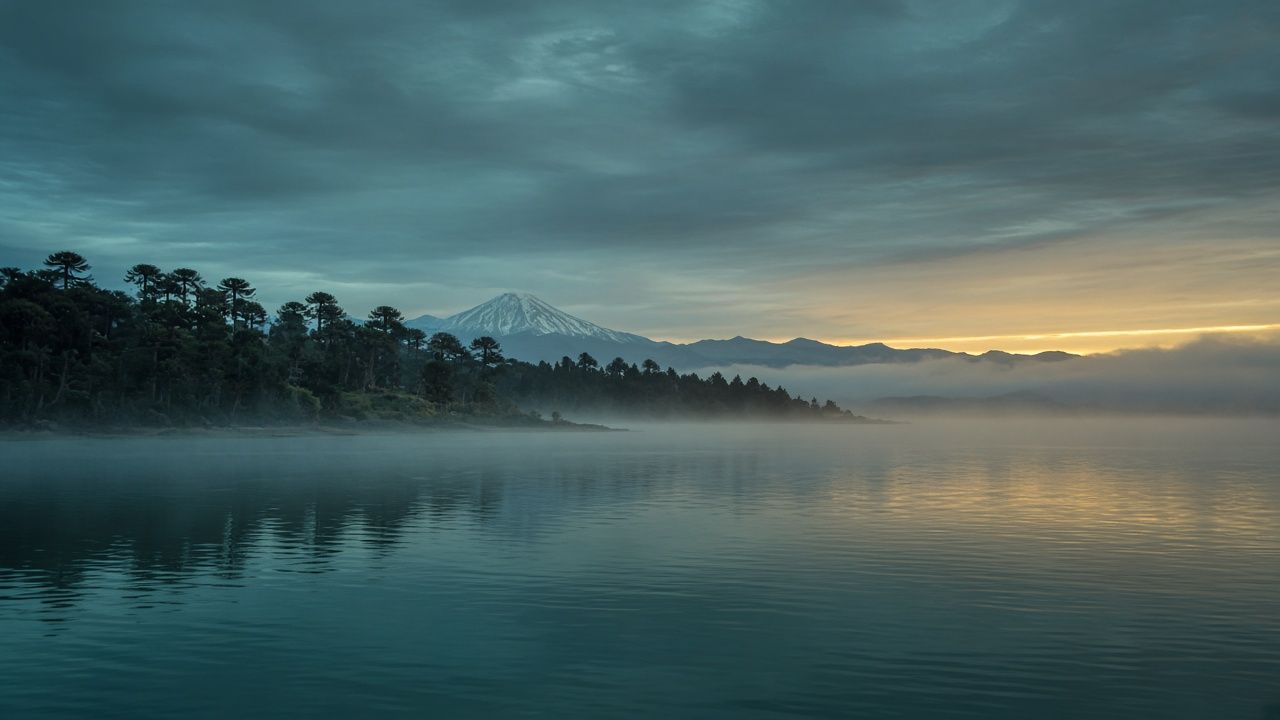
A territory where people can live, not just visit
Where the south is starting to repeat the same problem — and a practice that today begins in Villarrica, Pucón and Licán Ray. An invitation to build, rent and invest with those who stay and those who want to grow here in mind.
1. The problem
In many communes in southern Chile — lakes, mountains, tourist corridors — the same pattern is beginning to repeat: housing treated as a summer asset, people who work in the area with nowhere to stay, neighbourhoods that empty out of season. Curarrehue, Panguipulli, Puerto Varas, Frutillar are examples; the list is not closed. The movement speaks about this regional phenomenon.
We know the market in detail in Villarrica, Pucón and Licán Ray; the figures in section 4 bis are from that lake circuit. The same pattern is already visible in other communes in the south, even though the numbers cited come from those three hubs. It is extraordinary territory, and that is exactly why it is under pressure. In just a few years we have seen land and housing treated as one more financial asset: bought to resell, built for the summer, and advertised with promises of returns that have little to do with the quality of what is delivered.
The consequences show up in everyday life:
- Renting year-round is getting harder. Much of the supply goes to seasonal rentals, which in a few weeks earn what a year-round lease earns in months. For an owner who only looks at the number, the family that needs to live here all year loses out. In some areas, such as Licán Ray, finding a house to rent long term is almost impossible.
- Homes empty most of the year. Second homes fill neighbourhoods that fall silent in winter, without neighbours to sustain local shops, the school or the neighbourhood association.
- People who work here leave. Teachers, health workers, tourism, construction and service workers end up living further from where they work, or leave the area. A tourist destination that pushes out those who make it work becomes fragile.
- Low-quality construction sold as investment. Projects designed to hit the market fast, with minimal finishes, dubious permits or no thought for the southern climate, paid for later by those who live in them.
- Land prices rise with no return for the community. Land gets more expensive because of outside pressure, but that value does not come back as housing, services or stable jobs.
This has a name: gentrification and touristification. It is not unique to here; those of us behind this movement have seen it in other places where we have lived, and we know how it ends when nobody stops it: pretty towns where no one who knows them still lives.
We do not blame anyone who buys a house to rest in, or who rents in summer to make ends meet. We are talking about a model: one that treats the territory as something to extract from, not a place to live in. This manifesto was born in Villarrica, Pucón and Licán Ray and invites anyone who recognises the same problem in other communes in the south.
1 bis. When summer eats the year
We are not the first to say it. Between Villarrica, Pucón and Licán Ray — and the communes around them — municipalities, trade groups and neighbours have been working for years so the territory breaks out of seasonality, does not depend on two summer months, and generates activity and income all year. There are concrete instruments: Villarrica is updating its Tourism Development Plan with a sustainable, participatory approach; Pucón has a sustainable tourism unit aimed at overtourism and promotes the destination outside summer; and in Pucón, the Social Housing Working Table has for years put numbers to families without a home and with rental problems. We do not speak for any of them or claim they share everything we propose here. We share the goal, and we believe one piece is sometimes forgotten.
A place only works all year if people keep it working all year. Teachers, health workers, those who run local shops, services, workshops, construction. Without a stable workforce that can live near where they work and stay for more than one season, no school keeps its teachers, no clinic keeps its staff, no business opens in winter. Deseasonalising without housing for those who stay is asking the territory to function without the people who hold it up. That is why year-round housing is not separate from the area’s development: it is one of its conditions.
The landscape feels it too
The pressure is not only on housing. When visitors arrive in a few concentrated weeks, lakes and beaches feel it, rubbish piles up faster than it is collected, roads and access points clog, and services (water, waste collection, wastewater) sized for a much smaller population than in summer bear the load. We give no figures here because we have not measured them; anyone who has tried to reach a lakeside beach on a February weekend knows what we mean. A territory lived in all year spreads that load better and has neighbours who care for it outside the season too.
We have seen it elsewhere
Those of us behind this movement have lived in places where almost all rental housing turned into tourist lets: the Costa Blanca, Mallorca, the Pyrenees, Barcelona, several islands in Asia. This is not a comparative study or a legal comparison between Chile and those places; it is what we have seen with our own eyes, and the pattern repeats with frightening regularity:
- Local people leave. First those who rent, because they can no longer find anywhere; then those who work in what the place needs.
- Shops change customers. The bakery, hardware store and corner shop give way to souvenir shops and outlets that, in the end, not even tourists want to enter.
- The place loses its essence. What made it special was its own life, and that life leaves with those who lived it.
- Tourists stop wanting to come. Inflated prices, streets with only other tourists, crowded dirty nature, traffic jams, towns not prepared for so many people at once.
- The quality of tourism drops. The visitor who came for the place leaves; the one who only hunts for price arrives. Each season brings less for the same, or the same for something worse.
- In the end, income falls. And those who often fare worst are investors who bought on the promise of “great returns” sold by agents and developers, and who end up trying to sell in a market that is no longer the one they were told about.
It is bread for today and hunger for tomorrow: a very short-term view that, within a few years, eats away what made the place valuable. What a long-term lease does compared with a tourist rental in the numbers of one house is in section 4 bis; here we are talking about the whole territory, where the long-term account is even clearer.
2. What we believe
- The value of a place is its community. A neighbourhood with people who live there all year is safer, more alive and, in the long run, worth more. Community is not an obstacle to investment; it is what sustains it.
- Housing is, first, for living. Renting long term with clear contracts gives families stability and owners predictable income, and a home someone lives in all year does not stay empty. We prefer that stability to the summer peak.
- Roots before rotation. That a family can stay, that children remain in the same school, that someone who works in Pucón can live in Pucón and someone in Villarrica or Licán Ray near their work: that is what we want the market to make possible, not something that has to happen despite it.
- Aspiration within the territory. We want people who live here to stay; also that, when their situation improves, they can move up — rent a larger home, buy the next one, live in something of higher quality or comfort without having to leave the area or being pushed out by speculative prices. Roots are not stagnation.
- Business with ethics and a long view. We believe in the market, in private investment and in profitable business. We are not a manifesto against luxury or against those who earn well: we are for value staying in the commune, with clear rules and a horizon of decades. What we question is very short-term extraction that empties towns and burns the destination’s brand.
- Building well is a form of respect. Architecture for the climate and landscape, permits in order, materials that last. What is built today someone will inhabit for decades.
- Transparency is not optional. Prices, costs and conditions explained clearly, without fine print or inflated figures.
- Reasonable, sustained returns are enough. Investing in the territory can and should yield a return. What we reject is return obtained at the expense of those who live here.
3. What we reject
- Return promises without backing, presented as guarantees without explaining quality, risks and costs behind them.
- Speculative “flipping”: buying to resell quickly, adding nothing to the place but a higher price.
- Projects that pressure local land without social return: subdivisions and builds meant only for a quick sale, making the area more expensive without leaving housing, jobs or services for those who live there.
- Low-quality construction disguised as an investment opportunity.
- Treating tenants as a number, with opaque contracts, no maintenance or forced exits to switch to seasonal use.
We reject practices, not people. Anyone, including brokers and developers, can choose to work differently.
4. What we propose
We propose a movement and a practice.
A movement that puts the issue on the table: neighbours, owners, professionals and investors talking about what kind of territory we want in twenty years, and those who want to build, rent and invest with another criterion joining in.
A practice that is concrete, because ideas without practice change nothing. Those who join can apply these principles in Villarrica, Pucón and Licán Ray — where we know the market best — and in any commune in the south that recognises the same challenge:
- Prioritise long-term rental and primary housing over seasonal use.
- When a house is not rented all year, prefer seasons of several months over nightly rental. Tourist rental, only in high-end homes that do not compete with housing needed by those who work here, with criteria that avoid empty homes most of the year and, when appropriate, responsible operation (check-in, cleaning and maintenance between stays) so the house is not abandoned.
- Build with responsible architecture, permits in order and lasting quality.
- Explain honestly what an investment costs and yields, without inflated figures.
- Accept only mandates that fit these criteria, and say no to those that do not.
This is not about banning the season or stopping a family from prospering or an owner from investing in a better home: it is about seasonality and speculation not displacing those who live here. A season of several months is still housing for someone; a house that turns over every weekend is not. A well-managed high-end offer can coexist with housing for those who work in the commune, if each thing stays in its place.
There is no catalogue or brokerage here: we talk about the idea, go deeper and offer tools.
4 bis. Three ways to rent: numbers, risks and who lives in the home
Talking about returns without saying who lives in the house is telling half the story. These are the three ways of renting we distinguish, with figures from a market study in Villarrica, Pucón and Licán Ray1. This is an illustrative comparison, not a promise of results: what a specific house yields depends on the house, the year and how it is managed.
| Model | Typical income | Who lives there | Care of the property | Effect on the neighbourhood |
|---|---|---|---|---|
| Year-round, primary residence | Median about 535,000 CLP per month; three out of four listings at 600,000 or less1. It arrives every month. | Families, people who work in the area, those who make their life here | Generally high: it is their home | Home inhabited almost all year; neighbours who sustain school, commerce and the neighbourhood association |
| Season of 3 months or more (never by the day) | The study did not measure this segment; it sits between the other two | Someone coming to work, a project, or while finding where to settle | Intermediate: time to take care of it | Adds neighbours for months; gaps between one contract and the next |
| Tourist by the night (high-end homes only) | Median monthly equivalent of about 6.6 million CLP in current listings, only in occupied months1 | Visitors for days or weeks | Harder: cleaning and maintenance between stays | Constant turnover; empty home off season |
Twelve times more per month is not twelve times more in your pocket
Per occupied month, tourist rental is advertised at about twelve times what year-round rental asks. That is a real gap, and it explains why so many homes leave the housing market: the same study shows “March to December” contracts where the family rents ten months and leaves the house for the short summer season.
But that figure must be read carefully. The monthly equivalent assumes the house full every night of the month, and here tourist demand concentrates in summer and long weekends. To compare over a year: year-round rent at the median adds up to about 6.4 million gross (535,000 × 12). At the median tourist price, that equals roughly one fully occupied month. What the house earns the rest of the year depends on how many more nights fill, and each booking carries costs year-round rental barely has: cleaning and laundry between guests, furniture and equipment to replace, platform or management fees, utilities paid by the owner, more wear and more management hours. Long-term rental also has costs, and vacancy between contracts is one of them (in typical management, often 11% to 21% of gross income2), but they are more predictable.
We are not saying long term yields more in gross: with good occupancy, tourist can yield more. We are saying long term is more stable, depends less on a good summer, wears the house less and leaves neighbours. Everyone weighs those risks differently; we ask that they be put on the table.
An inhabited home does not stay empty
With year-round rental, someone lives in the house practically all year. While the contract lasts, the empty-home problem (months with no one to open windows, light the stove or spot a leak) is almost nil; it is reduced to the gap between one tenant and the next. With tourist rental the opposite happens: outside summer and long weekends, the house can spend much of the year with no one, and the “high occupancy” sometimes promised depends on demand nobody guarantees.
Another risk worries many owners: someone entering without permission and staying without paying. When a family lives in the house all year, with a clear contract stating who may live there, that possibility is almost nil: the home is inhabited by those entitled to be there. Homes empty for months, or with different people every few days, are more exposed, simply because there is more time with no one and less clarity about who should be there.
The word “occupancy” is used in three senses worth not mixing:
- Home inhabited or empty: for a neighbourhood, an occupied home is one where someone lives.
- Nights booked: in tourism, “occupancy” is the share of nights sold. A good booking rate can coexist with a home with almost no neighbours all year.
- Unlawful occupation: someone living in the home without title, whether they entered without permission or stopped paying and will not leave.
Contracts, arrears and recovery of the property
Long-term rental does not require blind trust. It requires getting the contract right from the start: identifying the tenant and authorised occupants, guarantees (one month’s deposit and, when appropriate, a guarantor if the tenant does not pay) and signatures authorised before a notary. Such a contract protects both sides: the tenant knows what they commit to and the owner knows what they can rely on.
If there is still non-payment, Chilean law provides tools. Since Law 21.461 (“Devuélveme mi casa”), rent collection and recovery of the home have a more agile procedure when the contract is well prepared. Nobody wants to use it, but knowing it exists allows long-term renting with peace of mind.
That is what it looks like in practice when done well: long-term housing contract, authorised occupants named in the contract, deposit, guarantor and notarised signatures. It is not a legal template (each case needs its lawyer), but it shows long-term renting with clear rules is possible and not a leap in the dark.
Who cares for the home
Someone who rents a home to live in it usually cares for it differently. They water the garden, report a dripping tap before it becomes a leak, tend the stove and firewood because they will spend winter with them, know the neighbours and try not to disturb them. It is not that holiday guests are careless: they are passing through, here to rest, and it is reasonable not to think about the gutter that will need cleaning in May. A season of several months sits in between: time to know the neighbourhood and take charge of the house.
It is not a rule without exceptions; there are neglectful tenants and impeccable visitors. But it is what usually happens, and it is one more reason, together with the neighbourhood, to prefer the long term.
5. Who this is for
If you are an owner
If you recognise this problem in any commune in the south, this movement speaks to you. If you have a house or land in the area, renting long term to a family that cares for and lives in the home gives stable income, less turnover and less wear than seasonal rental. If you cannot or do not want to rent all year, a season of at least a few months to someone coming to work or while finding where to settle still adds to the neighbourhood; nightly rental in homes that could be housing takes away. If you sell, you can choose who and for what — including a buyer who improves their home and stays in the territory. Every owner who chooses housing for those who live here shifts the neighbourhood map a little; earning well with a well-built, well-managed home is compatible with that.
If you rent or are looking for a home
You work or want to work in the area and need a home for the whole year, not three months. You deserve a clear contract, a home in good condition and dignified treatment. This movement exists, in large part, so finding that stops being the exception. And when your situation improves, we want you to move to a better home right here — more space, a better area, higher quality — without the market pushing you out of Villarrica, Pucón or Licán Ray.
If you invest
The territory needs capital: housing, and well built. We invite you to invest with a long horizon, a reasonable stable return, and the value a solid, content community creates around it. A home in a lively neighbourhood, rented to a family that stays, is a safer investment than one that depends on a good summer. Building or acquiring higher-end housing in the area is also legitimate when it does not compete with the home someone on a local wage needs. Several units can fit the same line: we do not reject those who build a portfolio, but each property must be managed with the same criteria — long term first, quality, transparency and effect on the neighbourhood — not as hoarding to leave homes empty or pull housing off the local market. If you want double your money in two years without quality or permanence, this is not your place.
If you are a neighbour
You live here, perhaps always. You know the lake in winter, you know who has left and why. Your voice matters more than anyone who arrived from outside, including us. We want to hear you: what worries you, what you would like to change and what should never change.
6. Join us
- Share this manifesto with anyone you think should read it.
- Write to us if you want to join, collaborate, propose something or tell us your experience: [email protected].
- If you are a local organisation, neighbourhood association, cooperative, professional or media outlet and want to talk, same email.
We do not ask for signatures or data to sell you anything. Just conversation.
7. Short version
Lacustre Vivo — A territory where people can live, not just visit.
In southern communes where the same script repeats — from Villarrica, Pucón and Licán Ray to other lake shores — housing is increasingly treated as a speculative asset: seasonal rentals displacing those who live here all year, homes empty most of the year and return promises without quality behind them. Those who work in the area end up leaving.
We believe in the market and in profitable business with ethics and a long view. The value of a place is its community: we want those who live here to stay and, when they can, move up without leaving. We propose building well, renting long term and explaining honestly what an investment costs and yields.
Owners, tenants, investors and neighbours: join in, share and let’s talk. lacustrevivo.com
(≈130 words)
Footnotes
-
Market study of rentals on plots, Villarrica, Pucón and Licán Ray, August 2026. 80 year-round listings (cap 1,000,000 CLP/month) and 56 short-season listings, 37 current. The seasonal monthly equivalent is nightly or weekly price scaled to a fully occupied month; from 900,000 to 26,400,000 CLP including high-end homes. Published prices, not actual income. ↩ ↩2 ↩3
-
Estimate of typical costs of a long-term rental (property tax, maintenance, vacancy and insurance), excluding management, August 2026. ↩